A continuation from my earlier post about Microsoft
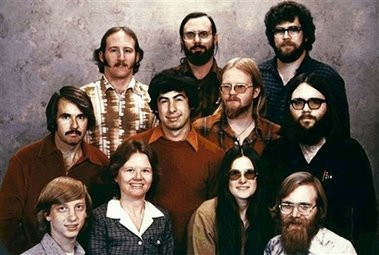
That photo of 11 weirdos in '70s clothes you may have seen on the Internet really is the original Microsoft team, snapped Dec. 7, 1978, on the eve of the company's move from Albuquerque, N.M., to Seattle. Almost 30 years later, a few weeks before Bill Gates's departure from Microsoft, the group (looking better) reconvened.
Bob Greenberg (center of old photo, in red sweater), then a programmer and now a tech and financial consultant, had won a photo portrait in a contest and used it to commemorate the soon-to-be disrupted group. The picture was shot in a shopping mall.
"The photo really does capture a moment of time and the spirit we had in the office," says cofounder Paul Allen (bottom right), now a media and sports mogul. Signing up for a little company in the then unknown field of PC software was a crazy leap of faith. "I could have had an office and a title from a respectable company—but I thought this would take off," says programmer Gordon Letwin (second row, right). He stuck around Microsoft until taking leave in 1993. Bob O'Rear (second row left, above Gates), the most experienced of the group (he'd been a NASA engineer, now he's a cattle rancher), concurs—sort of. "My concept of success for us was that someday we'd have 40 people or so."
Present for the reunion was office manager Miriam Lubow (center of new picture), who missed the original sitting due to a snowstorm. (When Lubow, now retired, first met Gates, she couldn't believe that disheveled kid was the president.) Absent for the reshoot was Bob Wallace (top center), who died in 2002; after leaving Microsoft in 1983, he pioneered the idea of shareware.
Though the meeting could have been tense—some in the group have many millions of dollars, others … not so much—it was joyous from the first. Steve Wood (top left), whose wife, Marla (third from left, bottom), was also an employee (he is now chairman of a telecom company; she does volunteer work), says that the photo isn't their legacy: "Our legacy is what we did."
A collection of words for the mind to reflect on and pictures that inspire the soul.
48 Things You Never Knew about Malaysia
http://www.kgomez.com/malaysia
Showing posts with label microsoft. Show all posts
Monday, June 23, 2008
Tuesday, August 22, 2006
Microsoft CEO discusses keys to success
Steve Ballmer visited Fargo on Thursday
Teri Finneman
Forum Communications
One of the world's richest men says there are four main reasons for his success in life.
Passion. Hard work. Seeing the big picture.
And the fourth?
"It doesn't hurt to go to college with Bill Gates," Microsoft CEO Steve Ballmer said, roaring with laughter. "In my case, that was helpful."
A vibrant man with an impish sense of humor, Ballmer spent Thursday in Fargo meeting with local employees and listening to updates on work being done at the Fargo campus.
Since 2000, Ballmer has served as Microsoft's CEO and assumed full management responsibility for the Redmond, Wash.,-based company. He joined Microsoft in 1980 and headed several of the company's divisions before being promoted to president in 1998.
He is now the 24th richest person in the world with a net worth of $13.6 billion, according to Forbes.
Ballmer, 50, grew up near Detroit before attending Harvard University to study math and economics. It was there he met Gates.
Ballmer later attended Stanford University Graduate School of Business in California, where he met Doug Burgum, who grew up in Arthur, N.D.
Burgum is now senior vice president of the Microsoft Business Solutions group based in Fargo.
Ballmer sat down with The Forum for an exclusive interview last week in Burgum's office.
(This story has been edited for length.)
Talk about why you're in Fargo.
I decided shortly after we acquired Great Plains (Software) that with as many people, as much important work as we're doing here in Fargo, it was important for me to try to get in regularly.
Basically, the time is kind of Doug's. He decides what we get into and talk about. If I have a particular topic of interest, we raise it.
This morning, I saw some fantastic demonstrations of work that's going on here that will show up in our Dynamics product line.
It's a pretty full day.
It's been five years since Microsoft acquired Great Plains. Do you still think that was the right choice?
I certainly am very convinced that the move to get into business applications was, for us, a necessary and right and important move.
I think that we certainly got ... not only a great product, but more importantly, we got a great set of talent in the Great Plains team.
Twenty-twenty hindsight, things haven't gone exactly the way we'd sketched out. We thought that some things that we'd be able to do in the marketplace we could do faster than we have.
But I'm still very, very pleased with the progress and incredibly happy that we did the acquisition.
What do you see for the future of the Fargo campus? How likely is an expansion within the next few years?
We've been growing the Fargo campus in a sense, I think, fairly steadily over the last several years.
We're always going to be smart about what's best done here, what's best done in other parts of the U.S., what's best done in other parts of the world. We have to be intelligent about that.
We also have to ask ourselves, in different disciplines, how much could we grow if we wanted to here?
But we've been growing steadily. We just added 30 new jobs that we're recruiting for here in Fargo.
I was teasing the guys here, that on a percentage of all people working basis, we employ a higher percentage of all people working in the state of North Dakota than we do any other geography. North Dakota is already No. 1.
Bill Gates announced this summer he's going to step back from the company's day-to-day operations over the next two years. What are your thoughts on that and what impact do you think that will have on the company?
Bill will be stepping out of the company and being part time.
He'll be chairman of the board. He'll be an adviser, and I know he'll be generous with me and the rest of the senior team with his time.
Two things I would say, which seem contradictory.
No. 1, you don't replace somebody like Bill Gates. Both because he's so famous and has so much history in the company and in the industry and has such a range of knowledge and is such a bright and talented person.
But with that said, I think our company is in better shape for the future than ever before in terms of the people and the talent that we have.
I don't think the company will in any way do anything but continue to accelerate in momentum.
How closely do you work with Gates?
I see Bill basically 80 percent, 90 percent of the days when we're both in town.
I've worked more closely with Bill Gates than any other person I've ever worked with, and he's worked with me much more closely than any other person he's ever worked with.
What is a typical work week like for you?
I sort of have two kinds of work weeks: one when I'm in Seattle, and one when I'm on the road.
I'm away from family about 68 nights a year - I keep a little spreadsheet budget on that.
When I'm in town, I drop my kids at the school bus or at school. I'm usually at work by about 8 a.m. Most of the time would be meetings, unfortunately, although I try to keep about one-third of my time in Seattle for myself - to think, to read, to work on projects.
My wife would tell you I'm home at 7 p.m. I would tell you I'm home at 6:30 p.m. The truth is probably someplace in between.
I do an occasional bit more work after the kids go to bed. I certainly always work Sunday night. After about 5 p.m., my wife and kids know they lose me because I'm going to go back into work mode.
I'm working 80, 90, 100 hours a week when I'm on the road. I'm mostly with customers, business partners and the like.
What do you like to do in your free time?
I do exercise fairly regularly, four or five days a week. I'm pretty good about that, whether on the road or in Seattle.
I enjoy playing golf ... that would be my only other hobby. I don't have a long list to give you, I'm afraid. (laughs)
What do you think is Microsoft's greatest achievement?
In a historical sense, I think you'd have to say somehow between us and Intel, we are the father and mother of modern computing and I think that's a great accomplishment
Teri Finneman
Forum Communications
One of the world's richest men says there are four main reasons for his success in life.
Passion. Hard work. Seeing the big picture.
And the fourth?
"It doesn't hurt to go to college with Bill Gates," Microsoft CEO Steve Ballmer said, roaring with laughter. "In my case, that was helpful."
A vibrant man with an impish sense of humor, Ballmer spent Thursday in Fargo meeting with local employees and listening to updates on work being done at the Fargo campus.
Since 2000, Ballmer has served as Microsoft's CEO and assumed full management responsibility for the Redmond, Wash.,-based company. He joined Microsoft in 1980 and headed several of the company's divisions before being promoted to president in 1998.
He is now the 24th richest person in the world with a net worth of $13.6 billion, according to Forbes.
Ballmer, 50, grew up near Detroit before attending Harvard University to study math and economics. It was there he met Gates.
Ballmer later attended Stanford University Graduate School of Business in California, where he met Doug Burgum, who grew up in Arthur, N.D.
Burgum is now senior vice president of the Microsoft Business Solutions group based in Fargo.
Ballmer sat down with The Forum for an exclusive interview last week in Burgum's office.
(This story has been edited for length.)
Talk about why you're in Fargo.
I decided shortly after we acquired Great Plains (Software) that with as many people, as much important work as we're doing here in Fargo, it was important for me to try to get in regularly.
Basically, the time is kind of Doug's. He decides what we get into and talk about. If I have a particular topic of interest, we raise it.
This morning, I saw some fantastic demonstrations of work that's going on here that will show up in our Dynamics product line.
It's a pretty full day.
It's been five years since Microsoft acquired Great Plains. Do you still think that was the right choice?
I certainly am very convinced that the move to get into business applications was, for us, a necessary and right and important move.
I think that we certainly got ... not only a great product, but more importantly, we got a great set of talent in the Great Plains team.
Twenty-twenty hindsight, things haven't gone exactly the way we'd sketched out. We thought that some things that we'd be able to do in the marketplace we could do faster than we have.
But I'm still very, very pleased with the progress and incredibly happy that we did the acquisition.
What do you see for the future of the Fargo campus? How likely is an expansion within the next few years?
We've been growing the Fargo campus in a sense, I think, fairly steadily over the last several years.
We're always going to be smart about what's best done here, what's best done in other parts of the U.S., what's best done in other parts of the world. We have to be intelligent about that.
We also have to ask ourselves, in different disciplines, how much could we grow if we wanted to here?
But we've been growing steadily. We just added 30 new jobs that we're recruiting for here in Fargo.
I was teasing the guys here, that on a percentage of all people working basis, we employ a higher percentage of all people working in the state of North Dakota than we do any other geography. North Dakota is already No. 1.
Bill Gates announced this summer he's going to step back from the company's day-to-day operations over the next two years. What are your thoughts on that and what impact do you think that will have on the company?
Bill will be stepping out of the company and being part time.
He'll be chairman of the board. He'll be an adviser, and I know he'll be generous with me and the rest of the senior team with his time.
Two things I would say, which seem contradictory.
No. 1, you don't replace somebody like Bill Gates. Both because he's so famous and has so much history in the company and in the industry and has such a range of knowledge and is such a bright and talented person.
But with that said, I think our company is in better shape for the future than ever before in terms of the people and the talent that we have.
I don't think the company will in any way do anything but continue to accelerate in momentum.
How closely do you work with Gates?
I see Bill basically 80 percent, 90 percent of the days when we're both in town.
I've worked more closely with Bill Gates than any other person I've ever worked with, and he's worked with me much more closely than any other person he's ever worked with.
What is a typical work week like for you?
I sort of have two kinds of work weeks: one when I'm in Seattle, and one when I'm on the road.
I'm away from family about 68 nights a year - I keep a little spreadsheet budget on that.
When I'm in town, I drop my kids at the school bus or at school. I'm usually at work by about 8 a.m. Most of the time would be meetings, unfortunately, although I try to keep about one-third of my time in Seattle for myself - to think, to read, to work on projects.
My wife would tell you I'm home at 7 p.m. I would tell you I'm home at 6:30 p.m. The truth is probably someplace in between.
I do an occasional bit more work after the kids go to bed. I certainly always work Sunday night. After about 5 p.m., my wife and kids know they lose me because I'm going to go back into work mode.
I'm working 80, 90, 100 hours a week when I'm on the road. I'm mostly with customers, business partners and the like.
What do you like to do in your free time?
I do exercise fairly regularly, four or five days a week. I'm pretty good about that, whether on the road or in Seattle.
I enjoy playing golf ... that would be my only other hobby. I don't have a long list to give you, I'm afraid. (laughs)
What do you think is Microsoft's greatest achievement?
In a historical sense, I think you'd have to say somehow between us and Intel, we are the father and mother of modern computing and I think that's a great accomplishment
Sunday, June 18, 2006
Microsoft Founders
This 1978 file photo made available by Microsoft Corp. shows the 11 people who started Microsoft. The photo was taken in Albuquerque, N.M., just prior to moving the company to the Seattle area. Shown top row, from left, are: Steve Wood, Bob Wallace and Jim Lane; second row, Bob O'Rear, Bob Greenberg, March McDonald and Gordon Letwin; and front row, Bill Gates, Andrea Lewis, Marla Wood and Paul Allen. Gates announced Thursday, June 15, 2006, that he will transition from day-to-day responsibilities at the company to concentrate on the charitable work of the Bill & Melinda Gates Foundation. Gates will continue as the company's chairman after transferring his duties over a two-year period. (AP Photo/Microsoft Corp., Ho, file)
Subscribe to:
Posts (Atom)