| What causes déjà vu? |
| Déjà vu, French for "already seen," is the sensation of feeling eerily familiar with a newly encountered object or situation. It's that slightly jarring state of mind that can be triggered by any number of stimuli: a photograph, a phrase, a hand gesture. The sense that you've been here before. Due to its ephemeral nature, there's very little scientific research on déjà vu. Although over 70% of people report having experienced the unsettling phenomenon, it does appear to affect people aged 15 through 25 more than any other age group. And according to How Stuff Works, it has been associated with temporal-lobe epilepsy. Some epileptics have reported feelings of deja vu that occur prior to and even during seizures. Theories abound as to the cause of déjà vu. Simple wish fulfillment? A cerebral cross-wiring that confuses the present with the past? A pre-existing anxiety acting out? The subject is obviously still ripe for scientific and artistic exploration. Maybe time will yield an answer. |
Tuesday, December 13, 2005
Interesting : What causes déjà vu?


Interesting : Is it theoretically possible for science to someday create a real lightsaber?
| Is it theoretically possible for science to someday create a real lightsaber? |
| Alas, young Skywalker, are the ready-made signature lightsabers and DIY varieties not satisfying enough for your role-playing entertainment? As tantalizing an idea as a fully functioning lightsaber might be, there are critical physics hurdles that even the most brilliant imaginations can't overcome -- first and foremost being the nature of light. Assuming your lightsaber would incorporate a kind of laser beam technology, could the saber have a tip, since light waves don't just stop but keep going? Such a device is more likely to bore a hole through the living room furniture than function like a luminous sword. There's a quandary. Also, following the physical rules set up by the Star Wars movies, a genuine lightsaber would cast a shadow, which laser beams can't do. Next is the "saber" or sword-like quality desired of such a weapon. We all remember the sights and sounds of Luke Skywalker and Darth Vader's clashing swordplay with sharp clarity. Could that be reproduced with laser beams? Well, no, it can't. This intriguing Canadian site says any slightly plausible design would have serious usability flaws, like a reliable power source for the super-hot lasers, the incorporation of cumbersome refraction devices to regulate the laser intensity, and the need to avoid any and all reflective surfaces (lest the light bounce back and fry your face). So now that we've busted all your Jedi dreams of a real lightsaber, are there any possibilities for futuristic weaponry left? There is a dim ray of hope in the form of a plasmasaber. Plasma is a state of matter that radiates a lot of visible light and heat, and contains magnetically repellent properties desired of a lightsword. While plasma's properties may make it better suited than lasers for a hypothetical weapon, any plasma weapon built today would resemble more a Sherman tank than a lightweight handheld weapon. |
Interesting : Is it really dangerous to put metal in the microwave?
| Is it really dangerous to put metal in the microwave? |
| Who among us hasn't had the impulse to stick a can of SpaghettiOs in the microwave and see if the whole thing will, maybe like, you know...blow up? Or at least black out every household in the neighborhood? Well, while the occasional spoon left in your microwaving coffee cup won't necessarily win you a Darwin Award, this little rogue science experiment is still not without consequence. The problem has to do with a phenomenon called "arcing ." Without getting all Mr. Science on you, it seems microwaves electrically charge the air between a metallic object and the metal contained in the oven walls. This ionized air produces an electric current like a small bolt of lightning that can spark. Sparking in the microwave is more likely when metal with sharp edges, such as forks or even crinkled aluminum foil, is left inside. And the arcing effect can actually melt or burn thin metal layers like those found in mugs with metal trim. Thus, the FDA recommends that you don't use metal and aluminum foil in a microwave, as they can damage the oven and also cause your food to cook unevenly. And while you're exercising caution, don't forget that just boiling water in a microwave can be dangerous as well. |
Interesting : How is a plane de-iced?
| How is a plane de-iced? |
| Carefully, we hope. Actually, the answer to your timely question includes a lesson in choosing your keywords wisely. A search on " plane de-ice" was not specific enough so we tried again, with the more focused "airplane de-ice." Included in the new search results was a link to an article titled "Keeping ice off airplane wings," from the archives of Mechanical Engineering magazine. An accompanying photograph shows a team working on the wings of a grounded plane. The caption reads: In conventional deicing, crews use heated glycol-based fluids to remove existing ice, then coat the airplane with ice suppressants to prevent new ice from forming.The article, which is a brief look at new technologies developed to detect ice on wings, also states that "[in-flight] ice is removed with engine heat or by inflating rubber bladders, called pneumatic boots, installed along the wings." We returned to our search results hoping for more answers and found a report on Aircraft Icing provided by the Aircraft Owners and Pilots Association (AOPA). The "Deicing and Anti-Icing Equipment" section of the site included additional details about those little rubber bladders and boots, among other things. In answering your question, we also learned a lesson in the relationship between keywords and spelling. Apparently there is no hyphen in "deice." So we searched on "airplane deice " and found a scattering of results that seem to corroborate our earlier findings. |
Interesting : How do birds land on electrical wires without getting shocked?
| How do birds land on electrical wires without getting shocked? |
| It isn't insulation that keeps those pigeons safely perched on high-voltage wires. It's the nature of electricity at work. Electricity is always trying to reach the ground, and if an electrical conductor (like a wire or cable) provides a path, electricity will follow it. Birds aren't grounded -- no part of them touches the ground -- so they don't act as conductors. But imagine a young pigeon with very, very long legs. If it sat with one foot on a power line and touched the ground with the other, it would experience a shock, and you'd most likely end up with roasted squab. Be warned -- you don't have to be standing on the ground to get a serious shock from power lines. If you stand on a ladder or roof and touch a high-voltage wire, you'll get a serious, maybe even fatal, blow. Electrical workers who work on power lines are protected by insulated clothing and gloves, and use insulated tools to prevent shock. As Newscientist.com notes, birds on power lines can pose serious problems, but robots that crawl along power lines may provide a solution. |
Interesting : How are underwater subways built?
| How are underwater subways built? |
| There are many components to underwater subway construction, but the key is the tunneling shield, a machine that made digging through water-bearing strata both safe and possible. The shield was pioneered in 1818 by Marc Isambard Brunel, a French naval officer living in England who noted how shipworms bore through wood, pushing sawdust behind them with the aid of their shell armor. Putting his observation to practical use, he built a giant iron shield that could push through soft ground while miners shoveled the dirt through shutter openings in the face. Brunel's technique was used in constructing the world's first underwater tunnel, built underneath London's River Thames and completed in 1843. Consequently, one of engineering's long-standing obstacles was removed, and similar devices were employed throughout Europe and the Americas. Perhaps the best known underwater subway today is the Channel Tunnel or "Chunnel," which connects Great Britain and France. Construction crews from the two nations worked together for three decades, employing powerful steel cylinders, hydraulic jacks, and air compressors to burrow under the waterway. The tunnel lining was completed by setting steel rings in place. The steel was later covered with masonry. So next time you travel on an underwater subway, thank the industrious little shipworm for inspiring the ride. |
Interesting : Does hot water really freeze faster than cold water?
| Does hot water really freeze faster than cold water? |
| The phenomenon you describe is one of modern science's few remaining mysteries and the source of much debate in certain circles. Given the right set of conditions, hot or warm water can freeze faster than cooler water. This strange phenomenon was described by the likes of Aristotle, Bacon, and Descartes, yet is named after the Tanzanian high-school student who demonstrated it in 1969. The Mpemba effect only occurs under very specific sets of conditions and is still not completely understood. Though the effect has been reproduced successfully in a number of experiments, no one can say with certainty why it happens due to the great number of variables involved. However, it is generally believed some combination of factors, such as evaporation, convection, conduction, and supercooling, may account for the Mpemba effect. You'll be glad to know that however mysterious the phenomenon is, the Mpemba effect is put to good use by many ice-cream makers, who use warm milk instead of cool to help their ice cream freeze more quickly. You may also be interested to know that for such a seemingly simple substance, water is surprisingly complex, and its behavior is poorly understood. The Mpemba effect is just one of 38 anomalies of H2O. |
--
Cheers,
Kenneth Gomez.
http://www.kgomez.com
"The heights by great men reached and kept, Were never attained by sudden flight, But they, while their companions slept, were toiling upward in the night."
Interesting : Can you please explain Einstein's theory of relativity and the reason why it is such a great theory?
| Can you please explain Einstein's theory of relativity and the reason why it is such a great theory? |
A little research on the Web revealed that Einstein introduced not one but two theories of relativity . The first one, A Special Theory of Relativity, was published in 1905 and it overthrew common sense perceptions and interpretations of space and time. The theory states that relative to the observer, both space and time are altered near the speed of light -- distances appear to stretch and clocks tick more slowly. Ten years later, Einstein's General Theory of Relativity challenged Newtonian assumptions about a "clockwork universe" and the nature of gravity. To Einstein, gravity is a local warp in the fabric of spacetime, rather than a distant force. This new theory of gravitation paved the way for scientists to first conceptualize, then study and simulate the behavior of black holes. But what's so special about relativity ? By creating two important ideas, Einstein developed his paradigm-shifting physics:
In the absence of gravity (a special-case scenario) intervals of time and/or length must depend on the speed of the system relative to the observer's frame of reference. This led Einstein to his famous realization that matter and energy are interrelated and to the famous formula that expresses this relationship mathematically: E = mc². (E is equal to energy, m is mass and c [constant] is the speed of light.) Experiments have shown that an atomic clock traveling at high speeds in a jet does indeed tick more slowly than the exact same clock on the ground. Through the exchange of articles, ideas, and equations with other scientists, Einstein worked out a "general" theory, publicized in 1915-1916, that accounted for the influence of gravity on the motion of bodies, the shape of space, and the flow of time. Einstein wrote, "General relativity is beautiful and simple (to a physicist), but mathematically it's very complicated and subtle." One of the great things about Einstein's theories is the exploration that they continue to generate. Scientists find new ways to test and communicate abstract concepts and models. In the words of physicist John Wheeler, "matter tells spacetime how to curve, and curved space tells matter how to move." Not sure what that means? Check out these movie simulations of the type of cosmic events that relativity aims to describe. |
Interesting : Can a very high-pitched scream really shatter glass?
| Can a very high-pitched scream really shatter glass? |
| If a scream resonates with the natural frequency of the glass for long enough, it's possible that the glass would shatter, but a variety of factors are involved. First, the type of glass matters. As Louis Bloomfield of How Things Work points out, the glass usually found in windowpanes and cups is relatively soft, so it vibrates poorly and has no strong natural frequencies. If you tap a glass of this sort, all you hear is a dull "thunk" sound. There's nothing with which a high-pitched sound can resonate. Crystal is better suited because it vibrates well and emits a clear tone when you tap it. Lead oxide is added to the glass, making the resulting crystal stronger than ordinary glass. Crystal wine glasses work well for this experiment because, in addition to being crystal, they are thin and delicate, and the tubular shape enhances the sound frequency. The real trick to breaking glass with sound is to match the sound's frequency to that of the glass. You might be able to do this with a scream, but it's easier for a singer with perfect pitch to create the right note, especially if that singer's voice is amplified. Each glass will have a slightly different natural frequency due to minute variations in shape and composition. When the high-pitched sound and the glass resonate, it causes the glass to vibrate. If the singer keeps singing the same note at high volume, eventually the glass will vibrate itself into pieces. |
The Bosman Legacy in Footbal
| Bosman's legacy still influential, 10 years on |
By Darren Ennis
BRUSSELS, Dec 13 (Reuters) - Ten days before Christmas 1995, soccer's rulers received an unwanted "gift" they have been saddled with ever since.
On December 15 1995 the European Court of Justice (ECJ) in Luxembourg delivered its ruling in the Bosman case and changed the game in Europe forever.
The ruling -- which dealt with the legality of soccer's rules on contracts and its restrictions on overseas players under European Union law -- was named after an obscure Belgian player Jean-Marc Bosman. Its effects were far from obscure.
It changed the rules on transfers, it changed the rules on the numbers of foreign players who could appear for teams and it transformed the bank balances of the best players in the world.
The irony was that it never enriched Bosman himself. Although he spent six years with Standard Liege in the 1980s, the catalyst for what became known as the Bosman Ruling was the collapse of his proposed move from RFC Liege to minor French club US Dunkerque in 1990.
What followed was a highly complex five-year legal battle that finally ended in December 1995 when the ECJ found that football's transfer system contravened the Treaty of Rome.
The court had dismissed appeals from world governing body FIFA, European governing body UEFA and letters from UEFA's then 49 national associations that a ruling in favour of Bosman would leave EU countries out of step with the rest of the world.
The ECJ ruled in favour of Bosman and a new era in the sport began.
Bosman told World Soccer magazine in January 1996: "I expected to win my case, but not so decisively. It was a total defeat for all my opponents.
"I feel proud I had the courage to do something no other player had the courage to try. I showed that football is not above the law.
"I hope that in the years to come other players will realise precisely how much I have done for them."
BILLIONAIRE OWNERS
Before Bosman, the clubs ruled the roost; after Bosman, the player became king with the best in the world earning millions from the game every year.
The ruling banned transfer fees for players out of contract and removed the limit on the number of foreigners clubs could field.
Bosman has had such a legacy that to attract the best players these days, clubs ideally need billionaires such as Roman Abramovich or Malcolm Glazer to grab the best players in the world.
Before the ruling, a club could receive compensation for a player even if he was out of contract. Otherwise they could stop the player moving, which was what sparked the Bosman case when Liege blocked his transfer to Dunkerque even though he was out of contract.
After the ruling, a club could no longer hold a player to ransom. If a player's contract was over, he became a free agent.
Instead of, for example, his club receiving 10 million pounds for his signature, the club would get nothing and the buyers could hand the player the money as his salary over the terms of the new contract they were offering him.
Running alongside this development was UEFA's Champions League, revamped from the old European Champions Cup in 1992 to provide more guaranteed top-quality matches for Europe's best sides.
UEFA was offering serious prize money, so the acquisition by the top clubs of the best players to ensure success in the competition -- as well as lucrative television payouts -- became a self-fuelling cycle that helped to change soccer's landscape.
It is now almost a forgotten footnote that before Bosman, clubs could not play all their best players in Champions League or UEFA Cup matches if they exceeded their foreign quotas as defined by UEFA's old "three-plus-two" rule.
That allowed them to play only three foreign players plus two "assimilated" players who might have come through a youth season. These days dozens of clubs fail to field a player from the country in which they compete and it barely raises a headline.
HOMEGROWN PLAYERS
UEFA and FIFA are still unhappy about this aspect of the Bosman Ruling and UEFA are planning to introduce a rule regarding "homegrown players" in their competitions from the 2006-2007 season.
The acceptance of this rule by the EU has not yet reached its conclusion and like the Bosman case it may yet end up in the courts.
While the leading players and clubs undoubtedly benefited from players, there were losers too.
A number of clubs went bankrupt because they could no longer rely on the transfer money that secured their futures when they sold on a big player.
Ticket prices shot up as clubs tried to limit their losses. Traditionalists wanted football to continue to be run as a sport, while others saw it as a business opportunity.
Today, FIFA and UEFA are more alert to the influences that the courts and the EU would like to exert on the game and are far more receptive to outside influences.
If they had been more receptive in the early 1990s, the Bosman case could have been solved within football -- and the huge changes it brought to the sport, for good and bad, might never have happened.
Bosman never reaped the benefits of his bravery and his football career ended in the late 1990s in obscurity but he left a lasting legacy.
Monday, December 12, 2005
Keep this philosophy in mind the next time you either hear or are about to repeat a rumour.
In ancient Greece (469 - 399 BC), Socrates was widely lauded for his wisdom.
One day the great philosopher came upon an acquaintance who ran up to him excitedly and said, "Socrates, do you know what I just heard about one of your students?"
"Wait a moment," Socrates replied. "Before you tell me I'd like you to pass a little test. It's called the Triple Filter Test."
"Triple filter?" asked the acquaintance.
"That's right," Socrates continued. "Before you talk to me about my student let's take a moment to filter what you're going to say. The first filter is Truth. Have you made absolutely sure that what you are about to tell me is true?"
"No," the man said, "actually I just heard about it."
"All right," said Socrates. "So you don't really know if it's true or not. Now let's try the second filter, the filter of Goodness. Is what you are about to tell me about my student something good?"
"No, on the contrary ...".
"So," Socrates continued, "you want to tell me something bad about him, even though you're not certain it's true?".
The man shrugged, a little embarrassed. Socrates continued." You may still pass the test though, because there is a third filter - the filter of Usefulness. Is what you want to tell me about my student going to be useful to me?"
"No, not really..."
"Well," concluded Socrates, "if what you want to tell me is neither True nor Good nor even Useful, why tell it to me at all?"
The man was defeated and ashamed. This is the reason Socrates was a great philosopher and held in such high esteem. It also explains why he never found out that Plato was shagging his wife.
One day the great philosopher came upon an acquaintance who ran up to him excitedly and said, "Socrates, do you know what I just heard about one of your students?"
"Wait a moment," Socrates replied. "Before you tell me I'd like you to pass a little test. It's called the Triple Filter Test."
"Triple filter?" asked the acquaintance.
"That's right," Socrates continued. "Before you talk to me about my student let's take a moment to filter what you're going to say. The first filter is Truth. Have you made absolutely sure that what you are about to tell me is true?"
"No," the man said, "actually I just heard about it."
"All right," said Socrates. "So you don't really know if it's true or not. Now let's try the second filter, the filter of Goodness. Is what you are about to tell me about my student something good?"
"No, on the contrary ...".
"So," Socrates continued, "you want to tell me something bad about him, even though you're not certain it's true?".
The man shrugged, a little embarrassed. Socrates continued." You may still pass the test though, because there is a third filter - the filter of Usefulness. Is what you want to tell me about my student going to be useful to me?"
"No, not really..."
"Well," concluded Socrates, "if what you want to tell me is neither True nor Good nor even Useful, why tell it to me at all?"
The man was defeated and ashamed. This is the reason Socrates was a great philosopher and held in such high esteem. It also explains why he never found out that Plato was shagging his wife.
Why Should You Defrag Your Hard Disk?
Windows comes with a collection of house cleaning tools, including ScanDisk, Disk Defragmenter and Disk Cleanup, to help keep your disk in peak working order.
Why should you bother with the housework? A couple of reasons. First, disks are hard working, mechanical devices and, like all mechanical devices, prone to failure. A little preventative maintenance can warn you of potential problems and fix minor glitches before they can do damage to your data.
Second, the way files are organised on your drive has a perceptible impact on the performance of your computer. If your files are stored neatly, end-to-end, without fragmentation, reading and writing to the disk is speedier.
What is file fragmentation?Sometimes when you install a program or create a data file, the file ends up chopped up into chunks and stored in multiple locations on the disk. This is called fragmentation.
What makes this happen?
When you first install your operating system and programs on your hard disk, they are written to the disk, for the most part, in one contiguous block without any gaps. The exceptions are certain system files that must be stored in specific locations. Over time, as you create and then delete documents or uninstall programs, once-filled locations are left empty and you end up with files dotted all over the disk.
Now, when Windows is writing a file to the disk, it looks for a suitable piece of free space in which to store it. What happens, then, when you copy a 40M database or audio file to the disk and the biggest slice of free space is only 30M? Or say you modify an existing file, appending a whole bunch of data so the file now takes up more space on the disk. To accommodate the files, Windows writes the first part of the file in one section of the disk and then scouts around for other places to store the rest of the file. The end result is that a single file may be stored in several chunks scattered about the disk.
Of FAT and files
Windows keeps track of each file's location in the File Allocation Table, or FAT (Windows 98 and Me use a file system called FAT32). When your file is written to disk, FAT32 provides Windows with the address of an unoccupied disk cluster. FAT32 also tells Windows on which disk sectors it will find that cluster; that is, it provides the physical location of the cluster. This information is used by your PC's BIOS (the Basic Input/Output System) to direct the actual disk writing operation.
If the file is too large to fit in a single cluster, Windows asks FAT32 for another vacant cluster, and another, and another until the whole file is written to disk. If you have lots of free clusters side by side, FAT32 can point Windows to an adjacent series of clusters, resulting in a file which occupies one contiguous chunk of the disk. If no adjacent cluster is available, FAT32 tracks down a space elsewhere on the disk and tells Windows to put the next bit of the file there; and so on until the full file is written to disk.
A record of the clusters used for storing the file is kept by FAT32 so Windows can find the file once more when you want to read it.
The fragmentation penalty
Although this all happens quickly, it makes a lot of work for your hard disk. Its read/write head, which moves across the drive platter from location to location transferring data, has to zip all over the place when saving or opening a single highly fragmented file. (By the way, many disks have more than one read/write head and multiple platters.) If a file is unfragmented, the disk head moves to one location, reads the file in one sequential swoop, and that's it.
A file stored in, say, four fragments, can easily take twice as long to open as the same file unfragmented, although the actual performance hit you take is affected by other factors, including the total size of the file.
Defragging
There's a simple solution to file fragmentation: use Windows Disk Defragmenter (Start –> Programs –> Accessories –> System Tools –> Disk Defragmenter). This utility, commonly called Defrag, gathers all the scattered file fragments and writes them into adjacent clusters, so each file occupies a contiguous section of the disk.
Defrag works by moving slabs of data to unused parts of the disk, in order to open up a large free section of space. It then assembles the fragmented parts of a file and writes them in one complete piece to the cleared space; it then does the same with the next file; and so on until the entire disk is defragmented.
Power Defrag
Disk Defragmenter is a utility which has been hobbled by the rapid advance of drive technology. It works just fine on a smallish disk of 8G or so; but use it on a 20G drive or one of the new 100G drives and you can say goodbye to using your computer for the most part of a day. (Although Microsoft says it's okay for you to use your computer while defragging, in practice this rarely works, because every write to disk causes Defrag to restart).
If you'd like to speed up Defrag and eliminate some of its problems, give Power Defrag a try.
Quote
"Democracy is a process by which people are free to choose the man who will get the blame."
Laurence J. Peter
Laurence J. Peter
Sunday, December 11, 2005
Interesting : What's the purpose of the little pocket in the right front pocket of jeans?
The answer to this one is easy -- coins. It has to be coins, right? We scoured dozens of online jeans listings. Pretty much every "classic five pocket design" boasted a coin pocket in the front right scoop pocket. Some of the coin pockets were exposed, some had flaps, some had insignias, but they were all described as coin pockets.
But then we stumbled onto a similar query on Ask MetaFilter and found the real answer -- watches. Back in the day before the wrist became multi-functional, folks carried pocket watches. These were fastened to the end of chains, and stored in special pockets woven into pants or vests.
Levi's 501s, originally introduced in 1890, featured watch pockets. And sure enough, after more snooping around, we found these vintage jeans from the 1970s listed as having "five pocket styling with watch pocket."
For more on pockets and their uses, the BBC has a surprisingly interesting essay entitled A Very Brief History of the Pocket. And this Smithsonian piece details the evolution of pocket watches to wrist watches.
Interesting : What are some of the most bizarre theories from the past of what the present would be like?
We humbly refer you to David Szondy's marvelous Tales of Future Past, a fascinating collection of classic science fiction illustrations and articles from popular American books and magazines. It's a veritable space mountain of vintage utopian visions.
Most of the scenarios here aren't all that bizarre: flying cars, space travel, megacities, gee-whiz gadgets. What's compelling is the sense of wonder and progress that dates much of this material to post–World War II America.
The military-industrial complex is well represented by the Gyro Electric Destroyer. In terms of getting around, your great-grandfather's Model T has nothing on the Dyno-Wheel. And millions of bored housewives of the future will take solace in the Autoboudoir.
What will the city of New York look like in 1975? Stretching even further into the future, what will life be like in the year 2000 AD? Hint -- all shopping will be done by videophone!
Many hypothetical future scenarios (most of them pretty grim) were generated during the Cold War. In fact, the American scientist Vannevar Bush predicted that society would one day be connected by a vast information grid known as "Memex." As if.
For further reading, we suggest you check out Bruce Franklin's survey of early science fiction classics. Dr. Elisa Spark of Clemson University also hosts a helpful index of futuristic scenarios.
Interesting : Why do golf courses have 18 holes?
Golf courses didn't always have 18 holes. The number of holes used to vary widely: 11, 22, 24, etc. As with most golf tradition-related questions, the reason why 18 became the standard goes back to St. Andrews of Scotland, the granddaddy of all golf courses.
The original course at St. Andrews (dating back to the 15th century!) consisted of 11 holes along a narrow strip of land next to the sea. Each hole was played twice, for a total of 22. In 1764, two of the holes were judged to be too short, so the course made the switch from 22 to 18 holes (nine holes played two times each).
In 1858, the Royal & Ancient Golf Club of St. Andrews, not an institution to be trifled with, issued an official decree that one round of links, or 18 holes, constituted an official match. Other courses pretty much followed suit, and by the 1870s, 18 holes was the standard.
One legend claims that the number 18 originated as a suggestion from one of the St. Andrews old-timers, who noted that it took exactly 18 shots to finish a fifth of scotch -- a shot per hole. However, this is just a rumor, so you can leave your hip flasks at home.
Interesting : What do bomb-sniffing dogs actually sniff for?
They sniff for a variety of explosives. Explosives, which often take the form of liquids or semi-solids, emit molecules with a particular scent. As this Salon article notes, dogs have 20 to 40 times more smell receptors than people do, and can be trained to react to specific scents.
Much of the science and training behind bomb-sniffing dogs is classified by the government. We do know that most of these dogs are trained at Lackland Air Force Base in San Antonio, Texas. We also know that bomb-sniffing dogs are " passive response" workers -- if they smell an explosive, they're trained to immediately sit and wait for their reward.
Dogs can identify dozens of mixed scents within a 5-foot radius. This helps trained dogs work effectively in environments that feature all kinds of curious odors, such as airport runways, indoor stadiums, border checkpoints, etc. Since the dogs rarely come across actual explosives, they're often given "dummy scents" to keep them attentive.
Perhaps the most famous bomb-sniffing dog of all was a brave pooch by the name of Sirius. Sadly, Sirius died in the September 11 attacks on New York City.
Interesting : What kind of salary does a crime scene investigator (CSI) usually earn?
That depends. If you're an actor who plays one on television, you can make a lot of money. "CSI" actor William Peterson reportedly makes $250,000 per episode.
Sadly, real crime scene investigators make much less than the fake ones. This 2004 want ad from the city of Philadelphia offers a starting salary of between $38,733 and $42,720 a year. The job description entails "locating, gathering, documenting, transporting, preserving and analyzing physical evidence from crime scenes."
A quick scan of the job postings on Crime-Scene-Investigator.net reveals a similar range of salaries. Starting CSIs in West Palm Beach, Florida, make just over $15 per hour. CSIs in Orange County make between $3,000 and $4,000 a month.
What's required to become a crime scene investigator? If you want to do lab work, you'll probably need a bachelor's degree in science. Some crime scene technician positions accept only police officers. Other jobs require only a GED certificate and some vocational course work.
Lesson learned? If you want to be a CSI, do it for the challenge, camaraderie, and satisfaction earned from fighting crime. But don't do it for the money.
Interesting : Is it true that most nursery rhymes have very morbid roots?
Yes, no, and sort of. For instance, this site about nursery rhymes claims that Ring Around the Rosy dates back to the Great Plague of London in 1665. But party-pooper Snopes debunks this as "nonsense," tracing that interpretation to a 1961 book.
The more likely explanation, says one historian, relates to the 19th century Protestant religious ban on dancing. Wikipedia writes that "generally nursery rhymes are innocent doggerel... Urban legends abound with regard to some of the rhymes, though most of these have been discredited." A spoof posted on Snopes parodied these apocryphal theories by claiming Sing a Song of Sixpence was originally used by pirates to attract new members. (Untrue.)
The provenance of many rhymes is interesting enough without resorting to sensational interpretation. Wikipedia calls "plausible," for instance, the theory that Pop Goes the Weasel tells a tale of silk weavers peddling their equipment to pawnbrokers for drinking money. This NPR story explains that in the language of Henry VIII's time, Goosey Goosey Gander associates the Catholic Church with prostitution. As for "Sing a Song of Sixpence," it tells the story of Henry VIII's ill-fated marriage to Anne Boleyn. And a complicated set of references in Yankee Doodle really just boils down to trash-talking between the British and Americans during the Revolutionary War.
There is at least one overtly morbid book of nursery rhymes: Heinrich Hoffmann's Der Struwwelpeter. These tales of horrific punishment for children who exhibit undesirable behavior must have traumatized many an unsuspecting, nose-picking tot.
Interesting : How do magicians "saw" people in half?
According to the Guinness Book of World Records, in 1921, the world's first faux hemicorporectomy was performed in London by illusionist Percy Selbit. In the original version, the girl was entirely enclosed in the box. So, the "ta-da effect" must have been somewhat underwhelming.
But time brings progress, and later that year the American Horace Goldin performed the trick in New York with his assistant's head and feet protruding from the box (the assistant, incidentally, was male). The rest is history.
As Wikipedia explains, the trick is fairly basic. The assistant just curls up in the top half of the box. Since the audience only sees the box from the side, it appears much less spacious.
But how do we explain the feet, which often wriggle and squirm? Well, if they're not fake and being powered electrically, they usually belong to a second assistant hiding inside the table upon which the box is resting.
The Mallusionist goes on to explain the mechanics behind several other variations of the trick. Incidentally, this is a great resource for finding how other kinds of illusions work. Rabbit from a hat, anyone?
Interesting : Who was the guy who asked Rosa Parks to give up her seat and whatever happened to him?
A bus driver named James F. Blake ordered Rosa Parks to give up her seat on December 1, 1955. When she refused, the driver said, "Well, I'm going to have you arrested." She replied, "You may go on and do so."
According to Wikipedia, Blake continued to work for the bus company for another 19 years after the Rosa Parks arrest. He died of a heart attack in Montgomery, Alabama in 2002.
Ms. Parks was sitting in the middle of the bus, directly behind 10 seats reserved exclusively for white people. All of the seats of the bus were filled when a white man entered. Following standard practice, the driver ordered all four African Americans sitting just behind the white section to stand so the white man could sit.
While she was often portrayed as a humble seamstress, Ms. Parks was an active member of the NAACP at the time, and was fully aware of the consequences of her actions. The bus sat abandoned in an Alabama field for many years until it was identified by its serial number. It is currently housed in the Henry Ford Museum in Dearborn, Michigan.
The Henry Ford Museum also features a fascinating diagram of exactly where Ms. Parks was sitting when she was arrested.
Interesting : Why do journalists [put] words in [brackets] when writing an [article] that contains an [interview]?
Journalists use brackets within quotations to put words in people's mouths. This isn't necessarily a bad thing! Sometimes journalists have to insert words to help to clarify a statement.
Brackets are often used to identify ambiguous pronouns in a direct quotation. For example: "They [the 8th Federal Infantry] fought bravely under the most adverse circumstances during the Civil War."
You can also use brackets to properly place a quote within the syntax of a sentence. To decapitalize a word, for example, "Doctor Fielding's written opinion states that '[p]atients are often deceitful.'"
Square brackets are also used in conjunction with the "[sic]" punctuation, which is a way of distancing yourself from a misstatement or a misspelling. For example, "The Delaware River is indeed a truly majestic site [sic]."
Finally, to quote usage guru Bryan Garner (and conveniently use square brackets in the process), "[Square brackets] enclose comments, corrections, explanations, interpolations, notes, or translations that were not in the original text but have been added by subsequent authors, editors, or others."
Interesting : How does the nozzle on the fuel pump know when to shut off to avoid overfilling the vehicle?
As How Things Work from the University of Virginia explains, gasoline nozzles have a small hole at the end that becomes blocked when gasoline rises to the top of the tank. Once this happens, the pressure drops inside a valve system built into the pump. This cuts off the gas flow.
If you want the nitty-gritty details, check out The Straight Dope. And if you don't believe us, check the end of the gas pump the next time you're at the station. You should be able to see the valve system hole.
We also found a suggestion from Dr. Ezra of Cornell University. He states the valve system is sensitive to air pressure within the tank, which increases as the tank fills with gas. Dr. Ezra, we respect your diploma, but this is simply not true.
And as to the rumors that cell phones can start gas station fires, Engadget and the MythBusters tells us that it just ain't so. Sadly, this hasn't stopped a Connecticut state senator from trying to introduce a bill requiring drivers to hang up their cell phones before filling their tank. Yeesh.
Do bees really die after they sting you?
It's true -- female honeybees die after they sting. Their stingers are actually ovipositors, tubular structures extending from the abdomen that sometimes contain eggs. When the barbed stinger is left inside the victim, the honeybee mortally tears her abdomen in the process. Alas, she dies.
Note, however, that only female honeybees die after stinging. Fortunately, honeybees are relatively docile, and only commit suicidal acts when provoked. And they only die if they sting a mammal, because of the thickness of our skin. They can sting other insects with impunity.
The mechanics of bee-stinging are fascinating. As Dr. Universe notes, a valve-and-piston motion causes the stinger to both sink itself into your skin, as well as pump venom through the tiny lancets. Also, an "alarm pheromone" secreted at the base of the stinger causes other bees in the vicinity to get riled up.
Fortunately, only about one out of a hundred people are allergic to bee stings, but allergic reactions can be very serious. Yahoo! Health suggests that if you are bit, don't squeeze the bite -- you'll just pump more venom into your system. Try gently scraping off the stinger with a butter knife or a credit card. Of course, if it really hurts, seek medical help.
How many people die each year worldwide?
According to the CIA World Factbook, as of July, 2005, there were approximately 6,446,131,400 people on the planet, and the death rate was approximately 8.78 deaths per 1,000 people a year. According to our nifty desktop calculator, that works out to roughly 56,597,034 people leaving us every year. That's about a 155,000 a day.
Still, more people are being born than dying. The population growth rate is hovering around 1.14%, which doesn't seem like much, but last year that was (back to the calculator!) 73,485,898 more mouths to feed. As the Factbook succinctly puts it: "For the 21st century, the continued exponential growth in science and technology raises both hopes (e.g., advances in medicine) and fears (e.g., development of even more lethal weapons of war)."
The legal information resource ItsMyLife.com offers some interesting mortality statistics for the United States. Of the 2,400,000-plus Americans who die each year, over 45,000 are killed in transport accidents. The number of homicides, poisonings, and drunk driving fatalities are roughly the same, at around 17,000 each. Perhaps more surprisingly, a stunning 178,000 Americans die from medical or hospital error every year.
For more details, the National Center for Health Statistics offers a free report. The United Nations also offers a 2005 World Health Report. One of its key findings: this year almost 11 million children under the age of five will die from a preventable disease.
Interesting : Why do we see spots after our eyes are exposed to bright lights like camera flashes?
As optometrist Kenton McWilliams of the MadSci Network explains, those blotchy shapes are formed by momentarily stunned bioluminescent microbes who live within your eyelid. Kidding! They're actually the result of the light-sensitive rods and cones in your retina becoming momentarily overwhelmed by an immediate influx of light.
As you may recall from your high school anatomy class, the rods register lightness and darkness, while the cones distinguish color. The rods vastly outnumber the cones; there are roughly 120 million rods to 7 million cones.
The cones are probably responsible for the strange colors involved, as they are concentrated in the central part of the eye. According to the American Optometric Association, your rods become more active in darker environments -- it can take up to 25 minutes for your eyes to become fully "acclimated" in a dark room.
If you're seeing spots without the benefit of a flash or a sudden change in ambient light, you may want to get to an eye doctor. You may also be interested to know that those strange shapes you occasionally see floating across your field of vision are known as "floaters," and are actually tiny clumps of cells floating inside the vitreous, or the clear jelly that fills your eye.
Interesting : How do they build bridges when water's in the way?
In the old days, building bridges required the sinking of many large rocks. Not the most elegant construction technique, maybe, but certainly quite effective. The Romans built bridges this way over 2,000 years ago that are still in use today, but most modern foundations for large bridges begin their lives as huge floating tanks.
During the construction of the Brooklyn Bridge, laborers worked in pneumatic caissons, or huge airtight cylinders full of compressed air. Conditions inside the caissons were notoriously miserable; twenty men died from fires, explosions, and something called "Caisson Disease," which we now know as the bends. No-one knew much about the effect of air pressure on the human body back then, and the designer, Washington Roebling, was paralyzed for life.
In the 1930s, workers on the San Francisco Bay Bridge used giant submersible caissons as actual bridge foundations. Initially buoyant, these huge steel contraptions were towed out to the bay, then gradually filled with concrete and water, and sunk. By that time diving technology had improved, so individual divers, or "sand hogs," assisted in the process.
The same method is used today -- huge metal caissons weighing up to 30,000 tons are floated out to a designated spot and then sunk. For example, the foundations for the Tacoma Narrows Bridge were pumped with 12,000 tons of sea water.
Why do some movies open in "select cities" first and then open everywhere else?
Smaller independent films are usually released in "selected cities" in order to build buzz and gauge audience response. These tend to be cities with a lot of media (and almost always start with New York and Los Angeles). More than studio productions with huge advertising budgets, smaller films depend on good reviews and word of mouth. If they do well on a few screens, they can then be released in more places.
All of the big studios have specialty divisions that release smaller budget films: Focus Features (Universal), Fox Searchlight, Sony Pictures Classics. Fox Searchlight's "Bee Season," for example, has recently changed status from "Now Playing in Select Theaters" to "Now Playing in Theaters Everywhere."
As this blogger from Atlanta perceptively notes, the select cities strategy usually means the film runs in Los Angeles and New York for a week or two, followed by Chicago, Seattle, San Francisco, and Boston for a little while. If all goes well, it opens nationwide. The blogger, incidentally, is disgruntled about Atlanta being deemed a "third-tier movie city."
Of course, "select cities" can mean different things depending on the subject matter of the film. For example, this Christian-oriented film was released in cities throughout the Midwest. Mel Gibson's "The Passion of The Christ" was also released in select suburbs rather than select cities.
Exactly how fast is a knot and how did it get that name?
Ahoy! For land-lubbers who don't know a sail from a sale, knots measure the speed of ships. A knot is one nautical mile per hour, so a ship traveling at five knots is traversing five nautical miles per hour. That's simple enough, but why, inquiring pirates want to know, is it called a knot?
The answer dates way back to the 17th century. To measure the speed and distance of a ship, knots were tied into a "log line ." This line was thrown overboard, an hourglass was tipped, and the knots were counted. When the sand ran out, the counting stopped, and a general speed was determined.
Which brings us to the next seafaring query -- how long is a nautical mile? We're glad you asked, matey. A nautical mile is equal to about 1.15 survey miles, or 6080 feet. According to this great page of nautical units and angles, a nautical mile is the angular distance of one minute of arc on the Earth's surface.
As HowStuffWorks explains, if you break up the equator into 360 degrees, then break up those degrees into sixty minutes each, a nautical mile is the equivalent of one minute. Alas, the Earth isn't a perfect sphere, so the arc minute distances tend to vary from the pole to the equator.
Interesting : Why is the letter "E" on top of all eye charts?
The standard eye chart is called the Snellen Chart, after the Dutch ophthalmologist Herman Snellen (1834-1908). Snellen developed the chart in 1862; it measures visual acuity, or the ability to see from a fixed distance.
Why the big "E?" That's how Snellen designed the original, and having a standard letter on top helps to determine the chart's size and the distance it should be from the patient. However, there are several variations of the Snellen chart: the letter "A" on top, "K V D" on top, as well as the letter "F."
The size of the letters relative to each other is very important. Snellen letters, also known as optotypes, grow progressively smaller according to a constant ratio. The eighth row of letters is usually the 20/20 line. Someone with 20/20 vision has "normal" vision (though 61% of Americans wear corrective lenses), while someone with 20/40 vision can only see at twenty feet what a normal person can see from forty feet.
Some charts use a series of "Es" facing different directions; the objective is to identify the directions of the letters. This is a popular test for children or people who can't read.
Wednesday, December 07, 2005
MSC.Nastran : Thermal Stress Analysis with TET10 Elements
Running a thermal analysis with TET4 elements gives better results than TET10, but when perfoming a structural analysis later, TET10 elements are preferred. How does one get around this.
Here's the trick :
If you use geometry for modeling, be mindful not to delete the mesh used for capturing the temperatures. One technique would be to
1) Create the course mesh using geometry.
2) Run the thermal analysis and create the Continuous FEM Field of the temperatures.
3) Disassociate all FEM from geometry.
4) Place the course mesh used by the Continuous FEM Field into a separate group.
5) Remesh the geometry for the structural analysis.
6) Map the temperatures from the Continuous FEM Field on the new mesh.
Here's the trick :
If you use geometry for modeling, be mindful not to delete the mesh used for capturing the temperatures. One technique would be to
1) Create the course mesh using geometry.
2) Run the thermal analysis and create the Continuous FEM Field of the temperatures.
3) Disassociate all FEM from geometry.
4) Place the course mesh used by the Continuous FEM Field into a separate group.
5) Remesh the geometry for the structural analysis.
6) Map the temperatures from the Continuous FEM Field on the new mesh.
Tuesday, December 06, 2005
MSC.Nastran : RESVEC
RESVEC - Controls the Calculation of Residual Vectors
Using the RESVEC parameter in MSC.Nastran controls to calculation of Residual Vectors.
RESVEC has the following parameters : INRLOD, APPLOD, RVLOD, DAMPLOD
Following are the explanation of these parameters :
Q1.) Does INRLOD always produces 6x (3 transl & 3 rotational) additional inertia relief shapes?
R1) Yes, for a fixed interface structure.
Q2.) What is the different (apart from 'bulk' definition) between RVDOF and APPLOD residual vectors ? Do not both use an unit load for estimation ?
R2) The RVDOF create a load vector at each dof ( i.e. 10 RVDOF = 10 load vectors = 10 displaced shapes). Whereas the APPLOD creates a load vector for each LOAD = (i.e. LOAD = 55 is one load vector and thus only one residual vector. This load could be a combination of FORCEs/MOMENTs/GRAV/PLOADs/etc.)
Q3.) Does APPLOD produces always in maximum 6 additional rigid body shapes for each inertia loads ? e.g. 3 loads -> 3 x 6 DOFs = max. 18 x inertia relief shapes ; is this also true for RVDOF ? From my experience RVDOF's produces only one additional shape per RVDOF entry !
R3) Total Residual Vectors =
APPLOD (i.e. subcases with LOAD=)
+ RVDOF (i.e. one load vector for each RVDOF)
+ INRLOD (i.e. inertia relief modes)
and if discrete dampers are present, one vector for each damper so that a representation of the mode associated with damping energy is retained in the modal space.
Here is an explanation on how the RESVEC vector works :
Using the RESVEC parameter in MSC.Nastran controls to calculation of Residual Vectors.
RESVEC has the following parameters : INRLOD, APPLOD, RVLOD, DAMPLOD
Following are the explanation of these parameters :
INRLOD Controls calculation of residual vectors based on inertia relief.
APPLOD Controls calculation of residual vectors based on applied loads.
ADJLOD Controls calculation of residual vectors based on adjoint load vectors (SOL 200 only)
RVDOF Controls calculation of residual vectors based on RVDOFi entries
DAMPLOD Controls calculation of residual vectors based on viscous damping.
APPLOD Controls calculation of residual vectors based on applied loads.
ADJLOD Controls calculation of residual vectors based on adjoint load vectors (SOL 200 only)
RVDOF Controls calculation of residual vectors based on RVDOFi entries
DAMPLOD Controls calculation of residual vectors based on viscous damping.
Q1.) Does INRLOD always produces 6x (3 transl & 3 rotational) additional inertia relief shapes?
R1) Yes, for a fixed interface structure.
Q2.) What is the different (apart from 'bulk' definition) between RVDOF and APPLOD residual vectors ? Do not both use an unit load for estimation ?
R2) The RVDOF create a load vector at each dof ( i.e. 10 RVDOF = 10 load vectors = 10 displaced shapes). Whereas the APPLOD creates a load vector for each LOAD = (i.e. LOAD = 55 is one load vector and thus only one residual vector. This load could be a combination of FORCEs/MOMENTs/GRAV/PLOADs/etc.)
Q3.) Does APPLOD produces always in maximum 6 additional rigid body shapes for each inertia loads ? e.g. 3 loads -> 3 x 6 DOFs = max. 18 x inertia relief shapes ; is this also true for RVDOF ? From my experience RVDOF's produces only one additional shape per RVDOF entry !
R3) Total Residual Vectors =
APPLOD (i.e. subcases with LOAD=)
+ RVDOF (i.e. one load vector for each RVDOF)
+ INRLOD (i.e. inertia relief modes)
and if discrete dampers are present, one vector for each damper so that a representation of the mode associated with damping energy is retained in the modal space.
Here is an explanation on how the RESVEC vector works :
Under 'typical' circumstances with a fixed interface structure, RESVEC first calculates BASE VECTORS (i.e. static displacements)
The APPLOD and RVDOF force a static analysis that creates displacement vectors that are the same as a SOL 101 analysis.
No inertia relief involved. (Base Vectors = number static subcases plus total number of RVDOF)
INRLOD can be thought of as applying a gravity/rforce to the structure and solving statically.
(Base Vectors = 6 vectors)
DAMPLOD can be thought of as a RVDOF applied at discrete dampers.
(Base Vectors = number of discrete dampers (i.e. cdamp))
The base vectors from the APPLOD/RVDOF/INRLOD/DAMPLOD are then compared to the normal mode vectors and linear combinations of the normal modes are removed from the static displacement vectors so that we don't count the same effect more than once. The residual vectors are 'higher order' modes because the lower order content is removed when the linear combinations of the normal modes are removed. These mode are also orthonormalized w.r.t. the mass matrix. (i.e. {Phi}^T [M] {Phi} = [I] )
The APPLOD and RVDOF force a static analysis that creates displacement vectors that are the same as a SOL 101 analysis.
No inertia relief involved. (Base Vectors = number static subcases plus total number of RVDOF)
INRLOD can be thought of as applying a gravity/rforce to the structure and solving statically.
(Base Vectors = 6 vectors)
DAMPLOD can be thought of as a RVDOF applied at discrete dampers.
(Base Vectors = number of discrete dampers (i.e. cdamp))
The base vectors from the APPLOD/RVDOF/INRLOD/DAMPLOD are then compared to the normal mode vectors and linear combinations of the normal modes are removed from the static displacement vectors so that we don't count the same effect more than once. The residual vectors are 'higher order' modes because the lower order content is removed when the linear combinations of the normal modes are removed. These mode are also orthonormalized w.r.t. the mass matrix. (i.e. {Phi}^T [M] {Phi} = [I] )
MSC.Nastran : Effective Modal Mass (MEFFMASS)
Modal effective mass indicates the mass participation of each mode in each of the 6 rigid body motions (T1< -> R3). It's only useful under constrained conditions (no Rigid Body modes).
Participation Factors can be negative, and the other outputs - Fraction, MEFF Wt, & MEFF Mass - are positive, related to the square of Participation Factors.
i) Fraction is generally the most useful output - Modal Effective Mass divided by total Rigid Body Active Mass - and adds to 1.0 when all modes are included. You're often looking for mode participations > 0.10 Fraction, and often want to calculate enough modes such that cumulative Modal Effective Mass Fraction > 0.9 in each direction. In your 30-mode example, T1 Fraction columns show mode 9 (look in your F06 file) as most significant in the X-translation direction, T2 shows mode 1 significant in Y-translation, and T3 does not show any significant mode > 0.10 in Z-translation, among the 1st 30 modes. That means you didn't calculate enough modes to show when Z-translation becomes distinctly active. Z-translation is the "stiffest" direction of your structure (under your current constraints), and higher-frequency modes participate in that direction.
ii) Modal participation factors are actually the "raw" cofficients of each mode which linearly combine to equal the rigid body vector in each direction. A high absolute value indicates a high participation in that direction. These values are squared & divided by modal mass to give the Modal Effective Mass values. Modal Effective Mass values are in turn divided by total Rigid body Mass in each respective direction to give Modal Effective Mass Fraction's.
iii) Modal Effective Weight & Mass columns show modal participations in wt or mass units, and add toward the total active Weight & Mass each direction. Total active mass is given by the diagonal terms on the 6x6 A-set Rigid Body Mass matrix, given at the top of the MEFFMASS output.
I generally only need Modal Effective Mass Fraction, and request the following:
MEFFMASS(FRACSUM,Grid=xxx)=YES
As related to my previous reply, selecting a reference grid other than Basic 0 may help give more meaningful and higher Rotation participation values. And RESVEC=Yes should give an approximate high frquency residual vector mode that participates in the Z-translation direction, which can help indicate at what modal frequency Z-translation becomes active.
Participation Factors can be negative, and the other outputs - Fraction, MEFF Wt, & MEFF Mass - are positive, related to the square of Participation Factors.
i) Fraction is generally the most useful output - Modal Effective Mass divided by total Rigid Body Active Mass - and adds to 1.0 when all modes are included. You're often looking for mode participations > 0.10 Fraction, and often want to calculate enough modes such that cumulative Modal Effective Mass Fraction > 0.9 in each direction. In your 30-mode example, T1 Fraction columns show mode 9 (look in your F06 file) as most significant in the X-translation direction, T2 shows mode 1 significant in Y-translation, and T3 does not show any significant mode > 0.10 in Z-translation, among the 1st 30 modes. That means you didn't calculate enough modes to show when Z-translation becomes distinctly active. Z-translation is the "stiffest" direction of your structure (under your current constraints), and higher-frequency modes participate in that direction.
ii) Modal participation factors are actually the "raw" cofficients of each mode which linearly combine to equal the rigid body vector in each direction. A high absolute value indicates a high participation in that direction. These values are squared & divided by modal mass to give the Modal Effective Mass values. Modal Effective Mass values are in turn divided by total Rigid body Mass in each respective direction to give Modal Effective Mass Fraction's.
iii) Modal Effective Weight & Mass columns show modal participations in wt or mass units, and add toward the total active Weight & Mass each direction. Total active mass is given by the diagonal terms on the 6x6 A-set Rigid Body Mass matrix, given at the top of the MEFFMASS output.
I generally only need Modal Effective Mass Fraction, and request the following:
MEFFMASS(FRACSUM,Grid=xxx)=YES
As related to my previous reply, selecting a reference grid other than Basic 0 may help give more meaningful and higher Rotation participation values. And RESVEC=Yes should give an approximate high frquency residual vector mode that participates in the Z-translation direction, which can help indicate at what modal frequency Z-translation becomes active.
Fast Cars, FEA, and More Integration in the Future
|
|
Sunday, December 04, 2005
Four Rules of Time
Four Rules of Time
There are four rules of time. The first is that time is perishable. This means that it cannot be saved. In fact, time can only be spent. Because time is perishable, the only thing you can do with it is to spend it differently, to reallocate your time away from activities of low value and toward activities of higher value. But once it is gone, it is gone forever.
Time Is Indispensable
The second rule of time is that time is indispensable. All work requires time. No matter what it is you want to do in life, even looking out a window or sleeping in for a few extra minutes, it requires a certain amount of time. And according to the 10/90 Rule, the 10% of time that you take to plan your activities carefully in advance will save you 90% of the effort involved in achieving your goals later. The very act of thinking through and planning your work in advance will dramatically reduce the amount of time that it takes you to do the actual job.
The Currency Of The Future
The third rule of time is that time is irreplaceable. Nothing else will do, especially in relationships. Time is the only currency that means anything in your relationships with the members of your family, your friends, colleagues, customers and coworkers. Truly effective people give a lot of thought to creating blocks of time that they can then spend, without interruption, with the important people in their lives.
Spell The Word Correctly
There is a question: “How do children spell the word ‘Love?’”
And the answer is “T-I-M-E.” It is the same with your spouse, as well. The important people in your life equate the amount of time that you spend with them, face to face, head to head, knee to knee, with the amount that you actually love them.
Grow Your Relationships
The more time that you spend with another person, especially a member of your family, the deeper grows your understanding and affection for that person. If you get too busy to spend time with your children, you eventually lose contact with them and they go off into their own personal world of school, peers and other activities.
The Key to Goal-Achievement
The fourth rule is that time is essential for accomplishment. Every goal you want to achieve, everything you want to accomplish, requires time. In fact, one of the smartest things you ever do, when you set a goal, is to sit down and allocate the exact amount of time that you are going to have to invest to achieve that goal. The failure to do this almost always leaves the goal unaccomplished.
Action Exercises
1. Decide today to redirect and reallocate your time away from low-value tasks and toward high-value activities.
2. Make a plan to spend more time face-to-face with the most important people in your life. The more you think about the use of your time, the better you will become.
There are four rules of time. The first is that time is perishable. This means that it cannot be saved. In fact, time can only be spent. Because time is perishable, the only thing you can do with it is to spend it differently, to reallocate your time away from activities of low value and toward activities of higher value. But once it is gone, it is gone forever.
Time Is Indispensable
The second rule of time is that time is indispensable. All work requires time. No matter what it is you want to do in life, even looking out a window or sleeping in for a few extra minutes, it requires a certain amount of time. And according to the 10/90 Rule, the 10% of time that you take to plan your activities carefully in advance will save you 90% of the effort involved in achieving your goals later. The very act of thinking through and planning your work in advance will dramatically reduce the amount of time that it takes you to do the actual job.
The Currency Of The Future
The third rule of time is that time is irreplaceable. Nothing else will do, especially in relationships. Time is the only currency that means anything in your relationships with the members of your family, your friends, colleagues, customers and coworkers. Truly effective people give a lot of thought to creating blocks of time that they can then spend, without interruption, with the important people in their lives.
Spell The Word Correctly
There is a question: “How do children spell the word ‘Love?’”
And the answer is “T-I-M-E.” It is the same with your spouse, as well. The important people in your life equate the amount of time that you spend with them, face to face, head to head, knee to knee, with the amount that you actually love them.
Grow Your Relationships
The more time that you spend with another person, especially a member of your family, the deeper grows your understanding and affection for that person. If you get too busy to spend time with your children, you eventually lose contact with them and they go off into their own personal world of school, peers and other activities.
The Key to Goal-Achievement
The fourth rule is that time is essential for accomplishment. Every goal you want to achieve, everything you want to accomplish, requires time. In fact, one of the smartest things you ever do, when you set a goal, is to sit down and allocate the exact amount of time that you are going to have to invest to achieve that goal. The failure to do this almost always leaves the goal unaccomplished.
Action Exercises
1. Decide today to redirect and reallocate your time away from low-value tasks and toward high-value activities.
2. Make a plan to spend more time face-to-face with the most important people in your life. The more you think about the use of your time, the better you will become.
The Four P's of Persuasion
The Four P's of Persuasion
Perception Is Everything
There are four “Ps” that will enhance your ability to persuade others in both your work and personal life. They are power, positioning, performance, and politeness. And they are all based on perception.
Develop Personal Power
The first “P” is power. The more power and influence that a person perceives that you have, whether real or not, the more likely it is that that person will be persuaded by you to do the things you want them to do. For example, if you appear to be a senior executive, or a wealthy person, people will be much more likely to help you and serve you than they would be if you were perceived to be a lower level employee.
Shape Their Thinking About You
The second “P” is positioning. This refers to the way that other people think about you and talk about you when you are not there. Your positioning in the mind and heart of other people largely determines how open they are to being influenced by you.
In everything you do involving other people, you are shaping and influencing their perceptions of you and your positioning in their minds. Think about how you could change the things you say and do so that people think about you in such a way that they are more open to your requests and to helping you achieve your goals.
Be Good At What You Do
The third “P” is performance. This refers to your level of competence and expertise in your area. A person who is highly respected for his or her ability to get results is far more persuasive and influential than a person who only does an average job.
Commit To Excellence
The perception that people have of your performance capabilities exerts an inordinate influence on how they think and feel about you. You should commit yourself to being the very best in your field. Sometimes, a reputation for being excellent at what you do can be so powerful that it alone can make you an extremely persuasive individual in all of your interactions with the people around you. They will accept your advice, be open to your influence and agree with your requests.
Treat People Politely
The fourth “P” of persuasion power is politeness. People do things for two reasons, because they want to and because they have to. When you treat people with kindness, courtesy and respect, you make them want to do things for you. They are motivated to go out of their way to help you solve your problems and accomplish your goals.
Being nice to other people satisfies one of the deepest of all subconscious needs, the need to feel important and respected. Whenever you convey this to another person in your conversation, your attitude and your treatment of that person, he or she will be wide open to being persuaded and influenced by you in almost anything you need.
Perception Is Reality
Again, perception is everything. The perception of an individual is his or her reality. People act on the basis of their perceptions of you. If you change their perceptions, you change the way they think and feel about you, and you change the things that they will do for you.
Action Exercises
Here are two things you can do immediately to put these ideas into action:
First, think continually about the impression you want to make on others and then make sure that everything you do or say is consistent with that perception.
Second, be nice to people. Practice the Golden Rule in your interactions with others. Always be polite and make others feel important.
The more people like you, the more open they are to being influenced by you.
Perception Is Everything
There are four “Ps” that will enhance your ability to persuade others in both your work and personal life. They are power, positioning, performance, and politeness. And they are all based on perception.
Develop Personal Power
The first “P” is power. The more power and influence that a person perceives that you have, whether real or not, the more likely it is that that person will be persuaded by you to do the things you want them to do. For example, if you appear to be a senior executive, or a wealthy person, people will be much more likely to help you and serve you than they would be if you were perceived to be a lower level employee.
Shape Their Thinking About You
The second “P” is positioning. This refers to the way that other people think about you and talk about you when you are not there. Your positioning in the mind and heart of other people largely determines how open they are to being influenced by you.
In everything you do involving other people, you are shaping and influencing their perceptions of you and your positioning in their minds. Think about how you could change the things you say and do so that people think about you in such a way that they are more open to your requests and to helping you achieve your goals.
Be Good At What You Do
The third “P” is performance. This refers to your level of competence and expertise in your area. A person who is highly respected for his or her ability to get results is far more persuasive and influential than a person who only does an average job.
Commit To Excellence
The perception that people have of your performance capabilities exerts an inordinate influence on how they think and feel about you. You should commit yourself to being the very best in your field. Sometimes, a reputation for being excellent at what you do can be so powerful that it alone can make you an extremely persuasive individual in all of your interactions with the people around you. They will accept your advice, be open to your influence and agree with your requests.
Treat People Politely
The fourth “P” of persuasion power is politeness. People do things for two reasons, because they want to and because they have to. When you treat people with kindness, courtesy and respect, you make them want to do things for you. They are motivated to go out of their way to help you solve your problems and accomplish your goals.
Being nice to other people satisfies one of the deepest of all subconscious needs, the need to feel important and respected. Whenever you convey this to another person in your conversation, your attitude and your treatment of that person, he or she will be wide open to being persuaded and influenced by you in almost anything you need.
Perception Is Reality
Again, perception is everything. The perception of an individual is his or her reality. People act on the basis of their perceptions of you. If you change their perceptions, you change the way they think and feel about you, and you change the things that they will do for you.
Action Exercises
Here are two things you can do immediately to put these ideas into action:
First, think continually about the impression you want to make on others and then make sure that everything you do or say is consistent with that perception.
Second, be nice to people. Practice the Golden Rule in your interactions with others. Always be polite and make others feel important.
The more people like you, the more open they are to being influenced by you.
How to Remove Any Software on Your PC
This question targets one piece of software, but the answer's general, and can work on any software that just won't uninstall properly.
Sometimes, old software won't uninstall properly. Other times, it does uninstall, but the "Add/Remove Software" list doesn't refresh: the software shows as installed, when it's not. Both problems aren't that hard to fix.
If you've been unable to uninstall via Control Panel's "Add/Remove Software" list, or via the program's own Uninstall applet, start by making a backup or (even better) an image of your hard drive.
Next, do a full search of your hard drive for any files or folders relating to the software in question: For example, search for anything containing the program's name or the owners/publisher's name. In the case of Spybot, it's easy: A search for any file or folder with "Spybot" in its name will turn up Spybot's folders and main files.
When you've found where the target files/folders are located, delete them all.
Next, use your Registry tool (eg Regedit) and search the Registry for any entries relating to the software in question. Again, you usually can find these by searching for anything containing the program's name and/or the owners/publisher's name. Delete any entries relating to the target software.
Reboot, so any in-use files will be released. Watch for any error messages at reboot: If they occur, they may contain clues as to the names and locations of any scattered files or settings you may have missed in the previous steps. Delete any such files you find this way, and/or change the affected settings (eg via Start/Run/MSCONFIG) that refer to the deleted files.
If you're being extremely thorough, do a second search of the drive and Registry to make sure that you really got everything the first time.
Run your favorite Registry-checker--- jv16, WinDoctor, or whatnot ( http://www.google.com/search?q=registry+check+repair ) to detect and repair any entries orphaned by your manual deletions.
The software should now be fully gone, but it's possible that there'll still be a ghost entry listed under Control Panel's "Add/Remove Software" list. If this happens, navigate to this Registry key:
HKEY_LOCAL_MACHINE\SOFTWARE\Microsoft\Windows\CurrentVersion\Uninstall
You can remove any item listed in the "Add/Remove" tool on Control Panel simply by deleting the appropriate subkey in the above. In the subkeys, "DisplayName" is the name you see listed in the Add/Remove Programs tool, and "UninstallString" is where the uninstall program is supposed to reside.
If you delete something this way, make a note to see where the Uninstall program is supposed to be: Check to make sure you deleted that file/folder, too.
When you're done, your system should be free of the files you were trying to delete, as well as any references to those files. This way, you should be able to remove even the most stubborn, deep-rooted software!
Sometimes, old software won't uninstall properly. Other times, it does uninstall, but the "Add/Remove Software" list doesn't refresh: the software shows as installed, when it's not. Both problems aren't that hard to fix.
If you've been unable to uninstall via Control Panel's "Add/Remove Software" list, or via the program's own Uninstall applet, start by making a backup or (even better) an image of your hard drive.
Next, do a full search of your hard drive for any files or folders relating to the software in question: For example, search for anything containing the program's name or the owners/publisher's name. In the case of Spybot, it's easy: A search for any file or folder with "Spybot" in its name will turn up Spybot's folders and main files.
When you've found where the target files/folders are located, delete them all.
Next, use your Registry tool (eg Regedit) and search the Registry for any entries relating to the software in question. Again, you usually can find these by searching for anything containing the program's name and/or the owners/publisher's name. Delete any entries relating to the target software.
Reboot, so any in-use files will be released. Watch for any error messages at reboot: If they occur, they may contain clues as to the names and locations of any scattered files or settings you may have missed in the previous steps. Delete any such files you find this way, and/or change the affected settings (eg via Start/Run/MSCONFIG) that refer to the deleted files.
If you're being extremely thorough, do a second search of the drive and Registry to make sure that you really got everything the first time.
Run your favorite Registry-checker--- jv16, WinDoctor, or whatnot ( http://www.google.com/search?q=registry+check+repair ) to detect and repair any entries orphaned by your manual deletions.
The software should now be fully gone, but it's possible that there'll still be a ghost entry listed under Control Panel's "Add/Remove Software" list. If this happens, navigate to this Registry key:
HKEY_LOCAL_MACHINE\SOFTWARE\Microsoft\Windows\CurrentVersion\Uninstall
You can remove any item listed in the "Add/Remove" tool on Control Panel simply by deleting the appropriate subkey in the above. In the subkeys, "DisplayName" is the name you see listed in the Add/Remove Programs tool, and "UninstallString" is where the uninstall program is supposed to reside.
If you delete something this way, make a note to see where the Uninstall program is supposed to be: Check to make sure you deleted that file/folder, too.
When you're done, your system should be free of the files you were trying to delete, as well as any references to those files. This way, you should be able to remove even the most stubborn, deep-rooted software!
Impoving Your Ideal Self and Life
Your Ideal Self and Life
Your self-concept is made up of three parts, each of which affects each of the others. Understanding these three parts enables you to put your hands on the keyboard of your own mental computer. When you learn to take charge of the development of a new and positive self-concept of selling, you can then control your sales destiny for the rest of your career.
Determine Your Direction
The first part of the self-concept is the "self-ideal." Your self-ideal largely determines the direction in which you are going with your life. It guides the growth and evolution of your character and personality. Your self-ideal is a combination of all of the qualities and attributes of other people that you most admire. Your self-ideal is a description of the person you would very much like to be if you could embody the qualities that you most aspire to.
Strive Toward Excellence
Throughout your life, you have seen and read about the qualities of courage, confidence, compassion, love, fortitude, perseverance, patience, forgiveness and integrity. Over time, these qualities have distilled in you an ideal to which you aspire. You might not always live up to the very best that you know, but you are constantly striving to be a better person in light of those qualities that you value so highly. In fact, everything that you do on a day-to-day basis is affected by your comparing your activities with these ideal qualities and your striving to behave consistent with them.
Clarity Is Essential
Successful salespeople have very clear ideals for themselves and their careers. Unsuccessful salespeople have fuzzy ideals. Successful salespeople are very clear about being excellent in every part of their work and their personal lives. Unsuccessful salespeople don't give the subject very much thought. One of the primary characteristics of successful men and women in every walk of life is that they have very clearly defined ideals and they are very aware of whether or not their current behaviors are consistent with their idealized behaviors.
Set Challenging Goals
Part of your ideals are your goals. As you set higher and more challenging goals, your self-ideal improves and crystallizes. When you set goals for the kind of person you want to be and the kind of life you want to live, your self-ideal rises and becomes a greater guiding and motivating force in your life.
Your Future Is Unlimited
Perhaps the most important thing for you to realize is that whatever anyone else has done or become, you can do or become as well. Improvements in your self-ideal begin in your imagination, and in your imagination, there are no limits except the ones that you accept.
What is your ideal vision of the very best person you could possibly become? How would you behave each day if you were already that person? Asking yourself these questions and then living your life consistent with the answers is the first step to creating yourself in your ideal image.
Action Exercises
Here are two things you can do immediately to put these ideas into action.
First, dream big dreams. Set big, exciting, challenging goals and ideals for yourself in every part of your life. Allow yourself to imagine a wonderful life ahead.
Second, think about how you would act if you were an outstanding person in every way. Then, practice being this person, as though you were acting a role in a play.
You’ll immediately notice a difference in your behavior.
Your self-concept is made up of three parts, each of which affects each of the others. Understanding these three parts enables you to put your hands on the keyboard of your own mental computer. When you learn to take charge of the development of a new and positive self-concept of selling, you can then control your sales destiny for the rest of your career.
Determine Your Direction
The first part of the self-concept is the "self-ideal." Your self-ideal largely determines the direction in which you are going with your life. It guides the growth and evolution of your character and personality. Your self-ideal is a combination of all of the qualities and attributes of other people that you most admire. Your self-ideal is a description of the person you would very much like to be if you could embody the qualities that you most aspire to.
Strive Toward Excellence
Throughout your life, you have seen and read about the qualities of courage, confidence, compassion, love, fortitude, perseverance, patience, forgiveness and integrity. Over time, these qualities have distilled in you an ideal to which you aspire. You might not always live up to the very best that you know, but you are constantly striving to be a better person in light of those qualities that you value so highly. In fact, everything that you do on a day-to-day basis is affected by your comparing your activities with these ideal qualities and your striving to behave consistent with them.
Clarity Is Essential
Successful salespeople have very clear ideals for themselves and their careers. Unsuccessful salespeople have fuzzy ideals. Successful salespeople are very clear about being excellent in every part of their work and their personal lives. Unsuccessful salespeople don't give the subject very much thought. One of the primary characteristics of successful men and women in every walk of life is that they have very clearly defined ideals and they are very aware of whether or not their current behaviors are consistent with their idealized behaviors.
Set Challenging Goals
Part of your ideals are your goals. As you set higher and more challenging goals, your self-ideal improves and crystallizes. When you set goals for the kind of person you want to be and the kind of life you want to live, your self-ideal rises and becomes a greater guiding and motivating force in your life.
Your Future Is Unlimited
Perhaps the most important thing for you to realize is that whatever anyone else has done or become, you can do or become as well. Improvements in your self-ideal begin in your imagination, and in your imagination, there are no limits except the ones that you accept.
What is your ideal vision of the very best person you could possibly become? How would you behave each day if you were already that person? Asking yourself these questions and then living your life consistent with the answers is the first step to creating yourself in your ideal image.
Action Exercises
Here are two things you can do immediately to put these ideas into action.
First, dream big dreams. Set big, exciting, challenging goals and ideals for yourself in every part of your life. Allow yourself to imagine a wonderful life ahead.
Second, think about how you would act if you were an outstanding person in every way. Then, practice being this person, as though you were acting a role in a play.
You’ll immediately notice a difference in your behavior.
CHAMPIONS LEAGUE : Liverpool vs Chelsea
CHELSEA V LIVERPOOL
Tuesday 6 December 2005 19:45
Liverpool play their final group game in the Champions League hoping to consolidate their position at the top of the table against second place Chelsea.
Both teams have already qualified for the last 16 of the competition so it will be interesting to see what sort of teams both manager's pick.
Liverpool played well in the game at Anfield that ended in a goalless draw and were unlucky not to have been given two penalties after replays proved they were stone-wall spot kicks.
The last time of the course the two sides met Chelsea won 4-1 in the Premiership clash at Anfield so the Reds will be hoping to restore some personal pride.
Tuesday 6 December 2005 19:45
Liverpool play their final group game in the Champions League hoping to consolidate their position at the top of the table against second place Chelsea.
Both teams have already qualified for the last 16 of the competition so it will be interesting to see what sort of teams both manager's pick.
Liverpool played well in the game at Anfield that ended in a goalless draw and were unlucky not to have been given two penalties after replays proved they were stone-wall spot kicks.
The last time of the course the two sides met Chelsea won 4-1 in the Premiership clash at Anfield so the Reds will be hoping to restore some personal pride.
Crouch Scores!

Peter Crouch finally scores for Liverpool after going 19 matches without scoring ever since joining Liverpool in the summer.
Well done Peter. I hope this is a start of your goal avalanche!


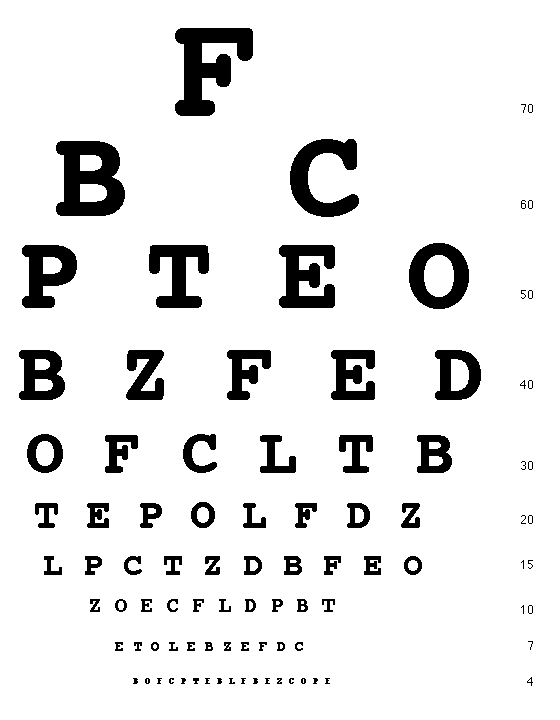
Subscribe to:
Posts (Atom)